How to Reduce OTA Commission for Hotels in India
OTA commission rarely feels like a crisis in the moment — it's a small percentage on one booking at a time. But across a full season, it's one of the biggest silent costs an independent hotel carries. The steps above don't require walking away from OTAs; they require building the direct channel alongside them, deliberately, and measuring the shift as it happens.
Table of contents

Every time a guest books through an OTA, 15–25% of that room revenue never reaches your account. It doesn't show up as one big bill you can point to and question — it just quietly leaves, reservation after reservation, until you check your numbers at the end of the month and wonder where the margin went.
The good news: you don't need to walk away from OTAs to fix this. You need a system that gets more guests booking direct, without losing the discovery OTAs bring you. This guide walks through exactly how independent hotels across India are doing that — step by step, not just theory.
Why OTA Commission Is Such a Big Problem for Independent Hotels
Commission rates vary by platform, but the range is fairly consistent across the industry. Booking.com and Agoda typically charge around 15–18% per booking. MakeMyTrip and Goibibo can run higher, depending on your contract and visibility tier. Add GST and payment processing on top, and a room that looks fully sold can quietly hand over a quarter of its value before you ever see it.
For a hotel chain with hundreds of rooms and deep marketing budgets, this is an annoyance. For an independent hotel, boutique property, or homestay running on 10–30 rooms, it's the difference between a healthy season and a break-even one. Every commission point matters more when your margins are already tight and you don't have a marketing team negotiating better OTA terms on your behalf.
This is why reducing OTA dependency isn't about principle — it's about protecting the revenue you're already earning.
Step 1 — Track Where Your Bookings Actually Come From
Before you can reduce commission, you need to know exactly how much of it you're paying, and to whom. Most independent hotels have a rough sense — "most of our bookings come from Booking.com" — but not an actual number.
Build a simple monthly report: total bookings by source (direct website, each OTA individually, walk-ins, phone), total revenue by source, and commission paid by source. This doesn't need to be complicated — even a spreadsheet works to start. What matters is that you have a baseline.
Without this data, you're optimizing blind. You won't know if your efforts to grow direct bookings are actually working, and you won't know which OTA is costing you the most relative to the bookings it brings in.
Step 2 — Build a Booking Engine That Actually Converts
A "Book Now" button on your website isn't the same as a booking engine that converts. Guests who land on your site are already interested — the job of your booking engine is to not lose them in the process.
That means a fast, mobile-friendly checkout (most of your traffic is on phones), visible trust signals like secure payment badges, and a clearly stated cancellation policy so guests don't hesitate at the last step. If your current site sends people to a contact form or a "call us to book" message, you're losing bookings you already earned through SEO, ads, or referrals — and pushing that guest right back toward an OTA.
Step 3 — Get Free Visibility via Google Hotel Ads and Google Maps
Guests are already searching for your hotel on Google before they ever open an OTA app. If your live rates and availability are connected to Google Hotel Ads and Google Maps, your direct price can show up right there — with no per-booking cost, unlike OTA placement.
This is one of the most underused channels for independent hotels in India. It doesn't require an ad budget in the traditional sense; it requires your rates being synced and visible where the guest is already looking. A guest comparing prices on Google and seeing your direct rate sitting right next to the OTA listings is far more likely to book with you directly.
Step 4 — Run Retargeting Ads for Website Visitors Who Didn't Book
Most people who visit your website won't book on that first visit. They're comparing dates, checking prices, maybe deciding between two or three properties. Without a follow-up, that interest quietly turns into a booking on whichever OTA reminds them first.
Retargeting ads on Google and Meta bring those visitors back to your site instead. The setup matters less than the consistency — AI-run ads that automatically adjust targeting and budget based on what's actually converting tend to outperform a "set it and forget it" campaign, especially for hotels that don't have a dedicated marketing person watching this daily.
Step 5 — Offer a Reason to Book Direct
Rate parity agreements usually mean you can't undercut your OTA price on your own site. But you can add value that OTAs simply don't offer: a best-rate guarantee, complimentary breakfast, a late checkout, or a small welcome amenity for guests who book directly.
For returning guests, a simple WhatsApp follow-up after their stay — checking in, sharing an upcoming offer — keeps you top of mind the next time they're planning a trip, so they come straight to you instead of searching OTAs again from scratch.
Step 6 — Keep Rates Synced So You're Never Underselling on Your Own Site
Nothing sends a guest back to an OTA faster than finding a lower rate there than on your own website. Rate mismatches usually aren't intentional — they happen when a rate is updated on one channel and someone forgets to update it everywhere else.
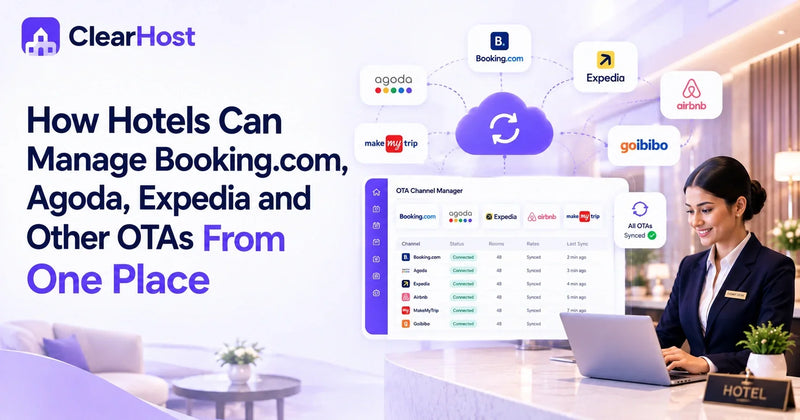
A channel manager that syncs your rates and availability across every OTA and your own booking engine automatically removes this risk entirely. Update the rate once, and it's accurate everywhere within seconds — so your direct channel is never quietly undercut by your own listings.
Step 7 — Measure the Shift Every Month
Reducing OTA commission isn't a one-time project — it's a trend you build and track. Revisit the same source-wise report from Step 1 every month. Watch your direct booking percentage move, and calculate the actual rupee amount saved in commission compared to your baseline.
Putting a real number on this — "we saved ₹1,84,320 in commission this month" — makes the impact tangible for you and anyone else involved in running the property, and it tells you clearly whether your efforts are working or need adjusting.
Real Example
The Saffron Boutique in Jaipur saw direct bookings grow by 32% after launching a proper booking engine on their own site. Instead of every guest defaulting to whichever OTA they found first, the hotel now captures a meaningful share of bookings commission-free — guests who book direct, pay direct, and the hotel keeps the full rate.
Quick Checklist — OTA Commission Reduction
- Track source-wise bookings monthly
- Optimize booking engine conversion
- List on Google Hotel Ads (free)
- Run retargeting ads for website visitors who don't book
- Offer direct-only perks (best-rate guarantee, breakfast, late checkout)
- Maintain rate parity via a channel manager
- Review commission savings every month
Frequently Asked Questions
1. How much commission do OTAs charge hotels in India?
Typically 15–25% per booking, depending on the platform and your contract terms. Booking.com and Agoda usually sit around 15–18%, while MakeMyTrip and Goibibo can be higher depending on your visibility tier and negotiated rate.
2. Can a hotel stop using OTAs entirely?
Not really, and it's not usually the right move. OTAs bring discovery, especially for first-time guests who've never heard of your property. The goal isn't to leave OTAs — it's to build a healthier mix, where direct bookings grow and OTA dependency shrinks over time.
3. How long does it take to set up a direct booking engine?
With the right platform, a live booking page can be published in minutes to a day. The bigger time investment is usually in optimizing conversion afterward — checkout speed, trust signals, and mobile experience.
4. Is maintaining rate parity legally required?
Most OTA contracts include a rate parity clause, meaning your direct rate can't be lower than what's listed on their platform. However, offering the same rate plus extra value — free breakfast, no booking fees, a better cancellation policy — is allowed and often just as effective at winning the direct booking.
5. What should a small independent hotel do first?
Start by tracking your current OTA-versus-direct split. You can't measure improvement without a baseline, and this one step usually reveals exactly where the biggest opportunity is hiding. After that, setting up a proper booking engine is typically the highest-impact next move.