OTA Channel Manager: How Hotels Can Boost Bookings
Manual OTA updates don't just risk double bookings, they quietly cap how many channels a hotel can realistically manage and how fast it can react to demand. This guide breaks down how an OTA channel manager actually drives more bookings: faster rate changes, protected OTA rankings, wider room-type visibility, and a foundation for reducing commission dependence through direct bookings. Includes a manual-vs-automated comparison table, a pre-signup checklist, and guidance on connecting your channel manager to a full PMS and booking engine.
Table of contents

Picture this. Your hotel is listed on six OTAs. A guest books a room on Agoda at 9am. Your front desk doesn't find out until 11am, because someone was busy with check-ins and the calendar update slipped. By then, that same room got booked again on MakeMyTrip. Now you're choosing between canceling one guest's reservation or scrambling to find them a room somewhere else, on your own dime.
This is the exact problem an OTA channel manager is built to prevent. And for hotels trying to grow bookings rather than just survive them, it's less of a nice-to-have and more of the foundation everything else sits on.
This guide covers what an OTA channel manager actually does, how it directly increases bookings rather than just preventing mistakes, and what to look for if you're evaluating one for your property.
What Is an OTA Channel Manager?
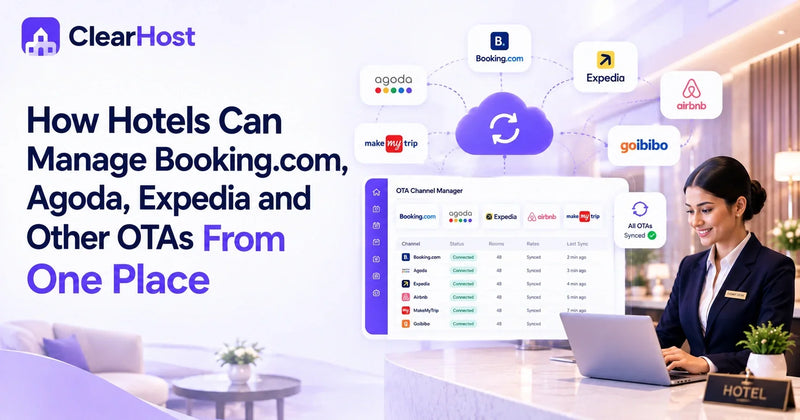
An OTA channel manager connects your hotel's inventory, rates, and availability to every online travel agency you sell through, MakeMyTrip, Booking.com, Goibibo, Agoda, Expedia, Airbnb, and so on, so that a change made in one place updates everywhere else automatically.
Without one, OTA hotel management means logging into each platform separately every time a rate needs adjusting or a room type sells out. That's manageable at three OTAs and a handful of rooms. It falls apart fast once you're running a real distribution strategy across six or seven channels with dozens of rooms and multiple rate plans.
The channel manager sits in the middle, talking to every platform at once, so your team makes one update instead of six.
Why "Boosting Bookings" Isn't Just About Preventing Errors
It's easy to think of a channel manager purely as a safety net, something that stops double bookings and nothing more. That undersells what it actually does for revenue.
More Channels, Managed Without More Staff
Every additional OTA you list on is another potential source of bookings. But each one also adds operational overhead if you're managing it by hand. A channel manager removes that overhead, which means you can realistically expand to more channels, wider geographic reach, and different traveler segments, without hiring another person just to keep the calendars straight.
Faster Rate Changes Mean Better Revenue Capture
Demand shifts fast. A local event gets announced, a competitor drops their rate, a long weekend suddenly looks busier than expected. If updating your price across six OTAs takes an hour of manual work, you're always reacting late. With real-time sync, a rate change goes live everywhere in seconds, so you can actually price to demand instead of pricing to whatever you managed to update before you got busy again.
Fewer Overbookings Means Better OTA Rankings
OTAs quietly reward properties with fewer cancellations and complaints by ranking them higher in search results. A property that keeps overbooking guests takes a visibility hit on the very platforms it depends on for bookings. Solving the sync problem isn't just about avoiding awkward phone calls, it protects your placement on the channels driving traffic to you in the first place.
More Availability Across More Room Types
Manually managing multiple room types across multiple OTAs often leads hotels to simplify, listing fewer room types or blocking availability out of caution. A channel manager makes it practical to list your full range of rooms, rates, and packages everywhere, which means more of your actual inventory is visible to more travelers.
Quick Comparison: Manual OTA Management vs an OTA Channel Manager
| Manual Management | OTA Channel Manager | |
|---|---|---|
| Rate updates | Logged into each OTA separately | One update, pushed everywhere instantly |
| Overbooking risk | High, depends on staff catching it in time | Low, real-time two-way sync |
| Time spent daily | 1-3 hours across platforms | Minutes |
| Scaling to more OTAs | Gets harder with each new channel | Stays roughly the same |
| Reporting | Manual spreadsheets, if done at all | Centralized dashboard |
| Staff dependency | High, mistakes happen when someone's busy or on leave | Low, automation doesn't take a day off |
How OTA Hotel Management Actually Works Day to Day
For a hotel that's set up properly, a typical day looks like this. A booking comes in on Booking.com. The channel manager registers it instantly and drops that room's availability across every other connected OTA and your own booking engine at the same time. Your front desk sees it reflected in the PMS without anyone touching a keyboard.
If you decide to raise the weekend rate because a local festival just got announced, you make that change once. It appears on MakeMyTrip, Goibibo, Agoda, and Airbnb within seconds, not after someone remembers to go update each one individually later that evening.
This is the difference between OTA hotel management as a daily chore and OTA hotel management as something that mostly runs itself, freeing your team to focus on the guest actually standing in front of them at the front desk.
What to Look For in an OTA Channel Manager
Not every tool marketed as a channel manager performs the same way in practice. A few things separate the ones worth paying for.
Real two-way sync, not one-way pushes. Some tools only push your availability out to OTAs but don't pull bookings back in fast enough. You want both directions happening instantly.
Coverage of the OTAs your guests actually use. For most Indian properties, that means MakeMyTrip and Goibibo alongside Booking.com and Agoda. A channel manager built primarily around Western OTAs will leave gaps for a domestic-heavy guest base.
Integration with your PMS and booking engine. A channel manager that operates as an island, disconnected from your front desk system, still leaves your team switching between tools. The stronger setup is one where the channel manager, PMS, and booking engine share the same data, so a booking made anywhere updates everywhere.
Clear, honest reporting. You should be able to see, at a glance, which OTA is sending you the most bookings and which one is quietly taking the biggest commission cut relative to what it delivers.
Support that responds when it matters. Sync issues tend to surface during your busiest weekends, not during a quiet Tuesday afternoon. A provider that only offers email tickets isn't much use when you need an answer in the next twenty minutes.
The Direct Booking Angle
An OTA channel manager isn't just about managing OTAs better, it's also the foundation for reducing how dependent you are on them. Once your inventory is synced properly across channels, adding your own booking engine into that same system means direct bookings pull from the same real-time availability, with no risk of conflicting with what's showing on Booking.com or MakeMyTrip.
This matters because every direct booking is a booking without a 15-25% commission attached. Hotels that treat their channel manager as step one, and their direct booking strategy as step two built on top of it, tend to see OTA dependence shrink gradually rather than staying stuck paying commission on nearly every room they sell.
A Short Checklist Before Choosing One
- Does it sync in real time, in both directions?
- Does it cover the OTAs your actual guests book through?
- Is it connected to your PMS and booking engine, or does it operate alone?
- Can you see clear, per-channel performance data without exporting spreadsheets?
- Is pricing reasonable for your room count, not built for a much larger property?
- Is there responsive support when something breaks on a busy weekend?
If a provider can't give you a straight answer on these, it's worth pausing before signing anything.
Bringing It Together
An OTA channel manager isn't just software that prevents mistakes in the background. Used properly, it's what makes it possible to list on more channels, react to demand faster, protect your ranking on the OTAs you depend on, and eventually shift more bookings toward your own direct channel instead of paying commission on every single room.
The hotels that get the most out of this usually aren't the ones with the most OTA connections. They're the ones where the channel manager, front desk, and booking engine all run off the same data, so nobody's chasing down a spreadsheet to figure out what actually happened last night.
Frequently Asked Questions
1. What's the difference between an OTA channel manager and a PMS?
A channel manager syncs your rates and availability across OTAs like Booking.com and MakeMyTrip. A PMS (property management system) handles your front desk operations, reservations, housekeeping, and billing. Many hotels now use a combined system where both live in one dashboard, so a booking updates everywhere without manual re-entry.
2. Can an OTA channel manager actually increase my bookings, or does it just prevent errors?
Both. Beyond preventing overbookings, it lets you list on more channels without adding staff, react to rate changes in real time, and protect your ranking on OTAs that penalize properties with cancellations. All of that translates into more visible availability and more bookings over time, not just fewer mistakes.
3. How many OTAs should a small hotel connect through a channel manager?
There's no fixed number, but most small to mid-sized Indian hotels see good results connecting to 4-6 channels that match their guest profile, typically MakeMyTrip, Goibibo, Booking.com, and Agoda at minimum, with Airbnb added for boutique or villa-style properties.
4. Does using a channel manager reduce my dependence on OTA commissions?
Indirectly, yes. Once your channel manager keeps inventory synced accurately, adding a direct booking engine on top of that same system lets guests book directly with you at the same real-time availability, without the OTA commission attached to that booking.
5. How quickly does a channel manager sync a new booking across platforms?
With a properly built real-time channel manager, sync typically happens within seconds of a booking coming in. Slower tools that batch updates every 15-30 minutes leave a window where double bookings can still slip through, so it's worth confirming sync speed before choosing a provider.