Best software solutions for managing multiple hotel properties in India from one dashboard
Explore how a hotel multi-property management system streamlines operations, centralizes bookings, and provides real-time insights across all your hotels from a single dashboard.
Table of contents

If you run three or more hotels in India, you need a hotel multi-property management system. One cloud login sits above each property's PMS and shows live occupancy, ARR, and RevPAR across every location, while a channel manager pushes rates to MakeMyTrip, Goibibo, Booking.com, and your own website so nobody re-keys anything. Platforms like ClearHost bundle the PMS, channel manager and booking engine into one dashboard with a portfolio view across properties and is budget-friendly. Before you look at any dashboard, check three things: does it charge GST on the invoiced room value, does Form C file to the FRRO without retyping, and do group reports come out without someone rebuilding them in Excel every Monday.
Why groups outgrow their old setup
Three hotels in one city run fine on three logins and a WhatsApp group. That breaks when the fourth opens in another city like Roorkee. You cannot see who is undercutting rates on Goibibo, or whether last night's audit closed. As hotel brands expand into cities beyond the metros, managing multiple properties becomes a challenge much earlier in their growth journey.
What a hotel multi-property management system does
Three layers, often confused:
- Property PMS. Front desk, housekeeping, folios and night audit at each hotel.
- Central reservation system (CRS). Holds group inventory, rate plans and guest profiles so one agent books any property.
- Group dashboard. Revenue, occupancy, ARR, RevPAR and inventory across the portfolio, with single sign-on into each hotel.
Some vendors sell a property dropdown and call it multi-property. Ask to see a side-by-side comparison report first.
Best software for hotel chains in India
Match the tool to the problem you have. Banquets, multiple Food and beverage outlets, and heavy back-office accounting call for a full-service enterprise PMS. OTA sync, rate parity, and not knowing where bookings come from call for the distribution layer first.
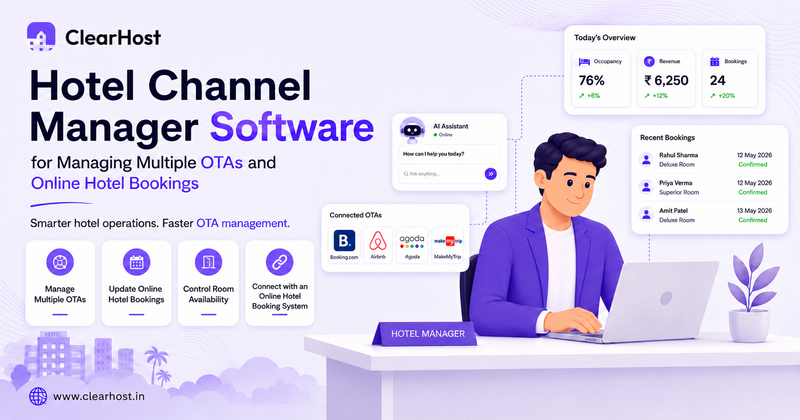
ClearHost covers the second case. PMS, channel manager and booking engine sit on one screen, syncing rooms, rates and availability across MakeMyTrip, Booking.com, Goibibo, Agoda and other channels in real time, so a rate change once pushes everywhere. For groups, an organisation dashboard shows performance across the portfolio and switches between properties in a click, with pricing scaling by room count rather than per property. Razorpay, Stripe and WhatsApp connect in, support is India-based, and around 500 properties run on it.
How to streamline operations across several hotel locations
- Fix your codes first. If Jaipur calls it Deluxe King and Udaipur calls it Premium Double, no group report is reliable. Standardise room types, rate plans and segments first.
- Centralise rates, distribution and reporting. Leave housekeeping and guest service at the property.
- Watch the night audit. You need an alert when a property has not closed.
- Define your metrics once. Agree how complimentary rooms, house use and no-shows are counted.
- Review four numbers weekly: occupancy, ARR, RevPAR and channel mix, by property.
What tools help with centralized booking for multiple hotels
- CRS for group inventory and multi-property itineraries on a single booking.
- Channel manager for two-way OTA sync. Skip it, and you will oversell a Saturday in peak season.
- Group booking engine so visitors search by city and date, not by hotel. Your highest-margin room nights.
- Central reservations office with role-based access, so agents sell everything but cannot change property settings.
What a portfolio dashboard should actually show you?
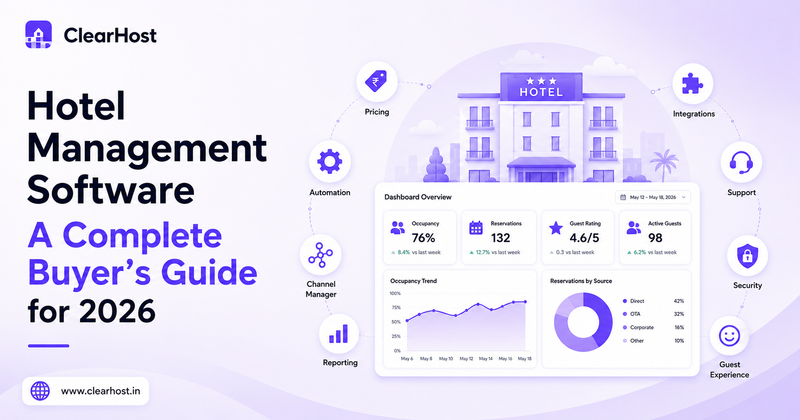
A single occupancy percentage across ten properties tells you nothing useful; you need the same numbers broken down property by property, refreshed live, not pulled from last night's batch export. Look for role-based logins so a General Manager (GM) sees only their property while the owner sees all of them, and confirm rate changes made at the group level cascade down without someone opening each property's PMS separately. If Diwali week pricing needs updating across six hotels, that should take one edit, not six logins. That's exactly the kind of problem a platform like ClearHost is designed to solve. It brings all your properties into one dashboard, so you can keep an eye on operations, reservations, rates, and performance without constantly switching between systems. And because growth doesn't stop at operations, ClearHost also includes AI-powered tools to help manage Google Ads and Meta Ads, making it easier to run campaigns, reach the right audience, and drive more direct bookings from the same platform.
FAQ
At what point should I switch to a multi-property hotel management system?
Three properties: Managing two properties with separate logins is still manageable, but once you add a third, a centralized system starts to make a real difference.
What is the best software for a hotel chain in India?
Depends on your Hotel. OTA sync and distribution point to a combined PMS and channel manager like ClearHost. Banquets and heavy accounting need a full-service enterprise PMS.
How long does setting up a system take?
An entire hotel chain typically takes 6–10 weeks, while implementing it for a single hotel usually takes 2–4 weeks.
What should I do first?
Write down your property count today, your target in three years, your budget per property, and your compliance must-haves. Judge three vendors on those four points.