Best Hotel PMS Systems in India (2026): Compared by Price, OTA Connections and Setup Time
Compare hotel PMS systems in India by monthly price, OTA connections and setup time. This guide covers what a small hotel actually needs and the hidden costs to ask about before you sign. It also shows how ClearHost connects your front desk with Booking.com, MakeMyTrip, Goibibo and Agoda.
Table of contents

The best hotel PMS system for most Indian hotels in 2026 is a cloud platform with a built-in channel manager, native two-way sync with Booking.com, MakeMyTrip, Goibibo and Agoda, and pricing based on room count. For a property of around 10 rooms, a system like this usually costs between ₹1,000 and ₹4,000 a month and can be live within a day or two. ClearHost is a hotel property management system built on this model for independent hotels, resorts and homestays in India.
Brand rankings go stale fast, and most "top 10 PMS" lists are written by a vendor who puts itself first. This guide takes a different route. It compares the five kinds of hotel PMS systems an Indian owner actually chooses between, and judges each one on price, OTA connections and setup time, since those are what decide whether the software makes your week easier or harder.
Hotel PMS systems in India at a glance
|
PMS type |
Best for |
Typical monthly cost (about 10 rooms) |
OTA connections |
Typical setup time |
|---|---|---|---|---|
|
All-in-one cloud PMS with built-in channel manager |
Independent hotels, resorts, homestays, small groups |
₹1,000 to ₹4,000 |
Built in, two-way |
Same day to a few days |
|
Cloud PMS plus a separate channel manager |
Hotels tied to an existing channel manager contract |
₹3,000 to ₹6,000 for both |
Through an integration |
One to three weeks |
|
Enterprise PMS |
Large hotels, chains, five-star properties |
Quoted on request, much higher |
Through integrations |
Several weeks to months |
|
Custom-built hotel software |
Properties with unusual workflows |
One-time build cost in lakhs, plus upkeep |
Whatever you build or pay to integrate |
Months |
|
No PMS (spreadsheets and OTA extranets) |
Very small properties on one or two OTAs |
Nothing in software, a lot in staff time |
Manual, one extranet at a time |
None |
Cost ranges are approximate. They reflect plans published by PMS providers in the Indian market in 2026 for a property of about 10 rooms, before 18% GST.
What is a hotel PMS system?
A hotel property management system (PMS) is the software a hotel uses to run daily operations from one screen: reservations, room allocation, check-in and check-out, housekeeping status, guest records, billing and reports. What the front desk used to keep in a register, a notebook and a WhatsApp group now sits in one place, and every department works from the same room status.
Most hotel PMS systems sold today are cloud based. You log in from a browser or a phone, the provider looks after servers and updates, and you can check tonight's occupancy without being at the property. That matters in India, where plenty of owners run a homestay in Coorg or a beach property in Goa while living in another city.
PMS vs channel manager vs booking engine: what's the difference?
These three tools are often sold together, and the names get mixed up in sales calls.
|
Tool |
What it does |
Who uses it |
|---|---|---|
|
PMS |
Runs internal operations: reservations, rooms, housekeeping, billing, guest profiles |
Front desk, housekeeping, managers |
|
Channel manager |
Sends rates and availability to OTAs and pulls their bookings back in |
Whoever handles distribution |
|
Booking engine |
Takes bookings on your own website |
Guests booking direct |
A PMS without a channel manager leaves someone updating every OTA extranet by hand. A channel manager without a PMS leaves the front desk working off a separate register. Most small hotels need both, and they work best when they share one inventory pool instead of passing data through a third-party connector. The ClearHost channel manager sits inside the same platform as its PMS, so there is nothing to integrate between the two.
What should the best hotel PMS do for an Indian hotel?
Feature lists look almost identical across providers. The real differences show up in five places.
Does it sync both ways with Indian OTAs?
For most independent Indian hotels, the bulk of online bookings comes from Booking.com, MakeMyTrip, Goibibo and Agoda. Your PMS should connect to each of them natively, through the OTA's own connection, and the sync should run in both directions. Rates and availability go out; bookings, modifications and cancellations come back in without anyone typing them.
Is the price tied to your room count?
For properties under 30 rooms, per-room or room-band pricing usually works out cheaper than a flat enterprise fee. Also check whether the provider takes a cut of each booking. A small commission doesn't look like much on one reservation, but it grows with every room you sell.
How quickly can you go live?
A working hotel can't pause for a month-long software rollout. Ask for a realistic go-live date, and ask who maps your room types and rate plans on each OTA. If the answer is "you", budget a lot more of your own time.
Can you run it from a phone?
Owners check occupancy from wherever they happen to be, and housekeeping staff shouldn't need a desktop to mark a room clean. A usable mobile interface has gone from a nice extra to a basic requirement.
Who answers when something breaks?
A sync failure on a Saturday night in peak season costs real money. Look for support during Indian working hours, by phone as well as email, and a named person who stays with you through onboarding.
Hotel PMS systems compared by type
1. All-in-one cloud PMS with a built-in channel manager
This is what most independent hotels in India now pick. The PMS, channel manager and (if you want it) booking engine share one inventory pool. When a room sells on Agoda, it closes on MakeMyTrip, Booking.com and at your front desk within seconds.
For about 10 rooms, expect to pay roughly ₹1,000 to ₹4,000 a month depending on which modules you take. OTA connections come built in and normally cover the major Indian OTAs plus global channels. Small properties are often live the same day or within a few days. The thing to watch for is a plan that charges extra for each OTA connection, or hides the channel manager behind the most expensive tier.
2. Cloud PMS with a separate channel manager
Some hotels run a PMS from one provider and a channel manager from another, joined by an integration. It works, but you pay two subscriptions and sometimes an integration fee on top. When a booking goes missing, each provider can point at the other. Every booking also takes one extra hop between systems, which is where sync delays and mapping errors tend to appear. This route makes sense if you're locked into a channel manager contract or need a specialist tool your PMS provider doesn't offer.
3. Enterprise PMS for large hotels and chains
Enterprise systems are built for hotels with 100 or more rooms, restaurants, banqueting, a spa and a central reservations team. They do a lot, and they're priced to match: quotes on request, implementation fees, paid training and a rollout that runs for weeks or months. For a 15-room boutique hotel, this is far more system than the property will ever use.
4. Custom-built hotel software
A development agency can build a PMS around your exact workflow. You pay a one-time build cost, usually in lakhs, and then hosting and maintenance every year. The weak spot is distribution. Every OTA connection has to be built, approved and kept working as OTAs update their systems. Unless your operation is genuinely unusual, an off-the-shelf cloud PMS gets you live sooner and keeps the OTA connections maintained for you.
5. Spreadsheets, WhatsApp and OTA extranets
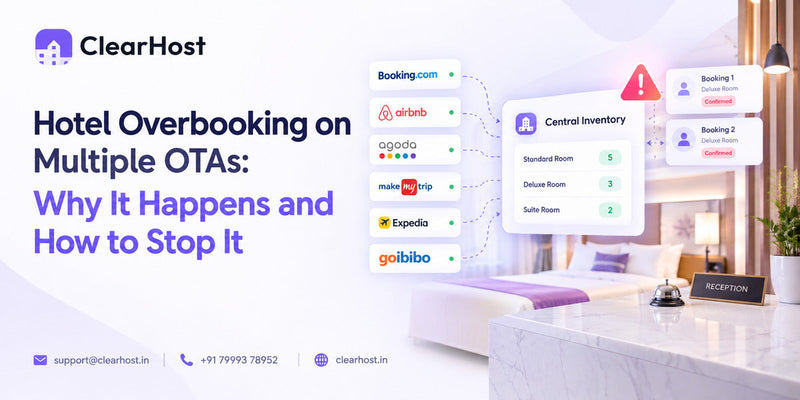
Plenty of small properties still run like this. The software costs nothing, but staff time doesn't. Every booking gets typed twice, every rate change means logging into each extranet one by one, and the gap between a room selling on one OTA and closing on the others is exactly when double bookings happen. ClearHost has a detailed guide on why hotel overbooking happens across multiple OTAs and what fixes it.
How much does a hotel PMS cost in India?
For a property of about 10 rooms, a cloud PMS with front desk features alone typically starts somewhere between ₹700 and ₹1,600 a month. Adding a channel manager puts most all-in-one plans between ₹2,500 and ₹4,000 a month. Indian providers usually quote prices before 18% GST, so add that when you compare.
Per-room pricing or a flat monthly fee?
Per-room (or room-band) pricing grows with your property, so a 12-room homestay isn't paying for features sized for a 120-room hotel. Flat fees can suit larger hotels. A simple way to compare: divide the flat monthly fee by the per-room price. If a flat plan costs ₹8,000 a month and a per-room plan works out to ₹200 a room, the two cost the same at 40 rooms. Below that, per-room pricing wins.
What hidden costs should you ask about?
The headline monthly price rarely tells the full story. Before you sign, get a written answer on each of these, and read ClearHost's guide on how to reduce OTA commission for hotels in India if commission is already eating your margin.
-
One-time setup or onboarding fees
-
Charges for each OTA connection beyond the first few
-
Paid add-ons for payment gateways, WhatsApp or accounting integrations
-
Per-user or per-login fees
-
A separate charge for every additional property
-
Commission on bookings, including direct ones
-
Price increases at renewal
ClearHost pricing at a glance
ClearHost uses room-based pricing with no setup fee and no commission on bookings. These are the listed prices for properties with up to 10 rooms, billed yearly, as of October 2026.
|
ClearHost plan |
What it covers |
Price (up to 10 rooms, billed yearly) |
|---|---|---|
|
PMS |
Front desk and stay view, reservations, check-in and check-out, housekeeping, billing |
₹719 a month + GST |
|
Channel Manager |
Unlimited OTA connections, live rate, inventory and availability sync |
₹1,529 a month + GST |
|
All in One |
PMS and Channel Manager, plus direct booking engine, AI assistant and revenue analytics |
₹2,699 a month + GST |
Every plan starts with a 30-day free trial, and you don't need a credit card to begin. You can also add or drop modules later. Larger properties are priced by room band, and current rates for each band are on the ClearHost pricing page.
Which OTA connections should a hotel PMS have in India?
Start with the four that fill most Indian hotel rooms
Booking.com, MakeMyTrip, Goibibo and Agoda are where most independent Indian properties start. MakeMyTrip and Goibibo belong to the same group, so a provider with a solid MakeMyTrip connection usually handles Goibibo well too. Confirm both anyway, along with any OTA you already depend on.
Add the channels your guests actually use
Villas and homestays often do well on Airbnb. Properties with a lot of foreign guests get more from Expedia, Agoda and Trip.com. Google Hotels free booking links put your rates in front of people searching on Google, and hostels need Hostelworld. A good PMS lets you switch these on when the demand is there rather than making you pay for all of them from day one. For reference, ClearHost's OTA connections include two-way sync with Booking.com, MakeMyTrip, Goibibo, Agoda, Airbnb, Expedia, Google Hotels, Yatra, Trip.com, Hostelworld, Hotelbeds and Klook, plus a wider network of global, regional and B2B channels.
Why two-way sync matters more than a long list of logos
A page full of OTA logos means very little if the sync is slow or only runs one way. In a one-way setup, rates go out to the OTAs but bookings don't come back on their own, so someone still has to enter each reservation and close the room on the other channels. Two-way sync closes availability everywhere as soon as a room sells. That, and not the number of logos, is what prevents overbooking.
Questions to ask a provider about OTA sync
-
Is each OTA connected directly, or through a third party?
-
How long does it take for availability to close on other channels after a booking?
-
Can I set different rates, minimum stays and closeouts for each channel?
-
Do you charge per OTA connection?
-
Who maps my room types and rate plans, and how long will it take?
If you're still logging into five extranets every morning, this walkthrough on managing Booking.com, Agoda, Expedia and other OTAs from one place explains how the switch works.
How long does it take to set up a hotel PMS?
A small hotel can usually go live on a cloud PMS in one to three days. Larger properties and enterprise systems often need two to four weeks or more because of data migration, extra integrations and staff training.
What does a realistic setup timeline look like?
|
Stage |
What happens |
Typical time for a small hotel |
|---|---|---|
|
Property setup |
Room types, rate plans, taxes, policies and staff logins |
A few hours |
|
Data import |
Upcoming reservations and guest records moved from your old system or spreadsheets |
Same day |
|
OTA mapping |
Each room type and rate plan matched to its listing on every OTA |
Same day to a few days |
|
Go-live check |
A test booking from each OTA to confirm availability closes everywhere |
On go-live day |
|
Staff training |
Front desk, housekeeping and managers |
An afternoon to a few days |
|
First-week review |
Look for failed updates, manual overrides and report totals that don't match |
End of week one |
With ClearHost, a dedicated onboarding specialist imports your rooms, rates, reservations and guest data, and the team maps your rooms and rates on each OTA with you. ClearHost says most properties are connected and live within a day, and it doesn't charge setup or onboarding fees.
What slows a PMS rollout down?
One of the most common delays is room names that don't match between your property and your OTA listings. Old listings nobody remembers creating cause trouble too, as do two channel managers left connected to the same inventory. Missing OTA login details and staff who weren't trained before go-live add more days. Sorting these out before onboarding day removes most of the wait.
What is the best PMS for small hotels?
For a small hotel, guesthouse or homestay with fewer than 30 rooms, the best PMS is a cloud system with a built-in channel manager, room-based pricing, simple daily screens and a setup measured in days. Small hotel management software doesn't need enterprise features. It needs to cut double bookings and the hours spent on extranets.
Which features should a small hotel insist on?
-
A reservation calendar that shows every room and booking at a glance
-
Quick check-in and check-out with payment collection
-
Live housekeeping status that staff can update from a phone
-
Two-way OTA sync with automatic stop-sell when a room type sells out
-
Guest profiles that recognise returning guests
-
A night audit and daily reports on occupancy, ADR and RevPAR
-
Support you can reach by phone
Which features can a small hotel skip for now?
Advanced revenue management, multi-outlet modules and complex group sales tools add cost without much benefit for a 12-room property. Get operations and distribution running smoothly first. Add modules once you can see where they'd pay for themselves.
Why hotels choose ClearHost as their hotel property management system
ClearHost is hospitality management software built for independent Indian hotels, resorts, boutique properties, homestays and small groups. It puts the PMS, channel manager, booking engine and analytics on one dashboard, so a rate change you make once reaches every connected channel.
On the operations side, the ClearHost hotel PMS covers:
-
A reservation calendar with month, week and day views, plus drag-and-drop to move or extend stays
-
A guided check-in that finds the booking by name, ID or phone number, assigns the room and records payments
-
A live housekeeping board, with a simple mobile view for housekeeping staff
-
Guest profiles with stay history, preferences and documents
-
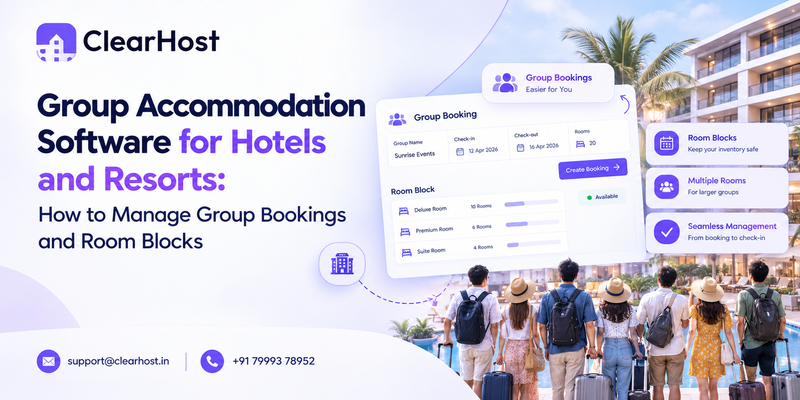
Group and corporate bookings with room blocks and allotments
-
An automated night audit
-
Rate plans, taxes and cancellation rules that you set once and apply across channels
On the distribution side, ClearHost gives you two-way sync with India's major OTAs and a wider global network, with unlimited OTA connections on the Channel Manager plan. Room types stop selling automatically when they sell out, and you can set channel-specific rates, markups, minimum stays and closeouts. ClearHost takes no commission on bookings, and your OTA contracts stay between you and the OTA.
Is ClearHost a good fit for boutique hotels and homestays?
Yes, and small properties are where room-based pricing helps most. A 10-room property pays for 10 rooms, not for a large hotel's feature set. The All in One plan for up to 10 rooms is listed at ₹2,699 a month plus GST, billed yearly, and housekeeping staff can work from a phone without training on the full system. For owners of small, character-led properties, ClearHost has a dedicated page on running boutique hotels with its platform, covering how a few rooms and a lot of returning guests change what you need from the software.
Can ClearHost manage resorts and multiple properties?
Yes. Resorts with several room types, seasonal rates and heavy housekeeping loads can manage rates, restrictions and room status from the same screen, so a peak-weekend price change and a late checkout are handled in one place. Owners with more than one property log in once, switch between properties from the top bar or view them together in group reporting, and pay per property by room band. If you're running a portfolio, see how ClearHost handles multi-property hotel groups.
How to choose the right hotel PMS: a six-step checklist
-
List every channel you sell through today, including walk-ins, phone bookings and travel agents.
-
Count your rooms and get prices for your exact room band, with GST included.
-
Ask each provider for a written list of every fee: setup, per OTA, per user and per property.
-
Confirm native two-way sync with every OTA you use.
-
Ask who does the room mapping and the date you'll be live.
-
Run a free trial with real bookings before committing to a yearly plan.
Frequently asked questions about hotel PMS systems
What is the best hotel PMS system in India?
There isn't one best PMS for every property. For most independent hotels, resorts and homestays, the best fit is a cloud PMS with a built-in channel manager, native two-way sync with Booking.com, MakeMyTrip, Goibibo and Agoda, room-based pricing and setup in days. ClearHost is built around this model for Indian properties.
How much does a hotel PMS cost per month in India?
For about 10 rooms, a PMS with front desk features typically starts between ₹700 and ₹1,600 a month. A combined PMS and channel manager usually costs ₹2,500 to ₹4,000 a month. Most Indian providers quote before 18% GST, and larger properties pay more because pricing scales with room count.
What is the best PMS for small hotels?
A small hotel needs a cloud PMS with a reservation calendar, quick check-in, live housekeeping status, two-way OTA sync and phone support. Room-based pricing keeps the cost in line with property size. Enterprise PMS systems are usually more than a small hotel needs.
Do I need a channel manager if I already have a PMS?
If you sell on more than one OTA, yes. The PMS runs your internal operations, while the channel manager keeps rates and availability matched across OTAs. Without one, staff update each extranet by hand, and overbookings become likely. A PMS with a built-in channel manager avoids paying for and connecting two separate systems.
Which OTAs should a hotel PMS connect to in India?
Start with Booking.com, MakeMyTrip, Goibibo and Agoda. Add Airbnb for villas and homestays, Expedia and Trip.com for international guests, Google Hotels for search visibility, and Hostelworld for hostels. Check that each connection is native and two-way.
How long does it take to switch to a new hotel PMS?
A small hotel moving to a cloud PMS can usually go live in one to three days, including data import and OTA mapping. Larger hotels and enterprise systems often take two to four weeks or more. ClearHost says most properties are connected and live within a day, with its team handling the mapping.
Is a cloud PMS better than on-premise hotel software?
For most small and mid-size hotels, yes. A cloud PMS needs no local server, updates automatically, works from a phone and lets owners check the property from anywhere. On-premise software suits hotels with strict in-house IT requirements, and it usually costs more to install and maintain.
Can one PMS manage multiple hotel properties?
Many cloud PMS systems can. ClearHost lets owners manage every property from one login, switch between them from the top bar and view group reports, with pricing per property based on room band.
Does ClearHost charge commission on bookings?
No. ClearHost charges a flat monthly fee based on room count. It doesn't add commission on OTA bookings or direct bookings, and your OTA contracts stay between you and each OTA.
Can I try ClearHost before paying?
Yes. Every ClearHost plan comes with a 30-day free trial, and you don't need a credit card to start. There are no setup or onboarding fees.
See ClearHost running on your own property
Comparing hotel PMS systems on paper only gets you so far. The quickest way to judge one is to watch it handle your own rooms and the OTAs you already sell on. Book a 20-minute ClearHost demo to see your rooms mapped across your channels, or start a 30-day free trial with no credit card. If you'd rather talk first, call +91 79993 78952 or email support@clearhost.in.